Trust your data
- Find tracking and configuration issues
- Detect data pipeline and integration problems
- Improve data quality and reliability
- Recommend the fixes
Don't just automate. Optimize.
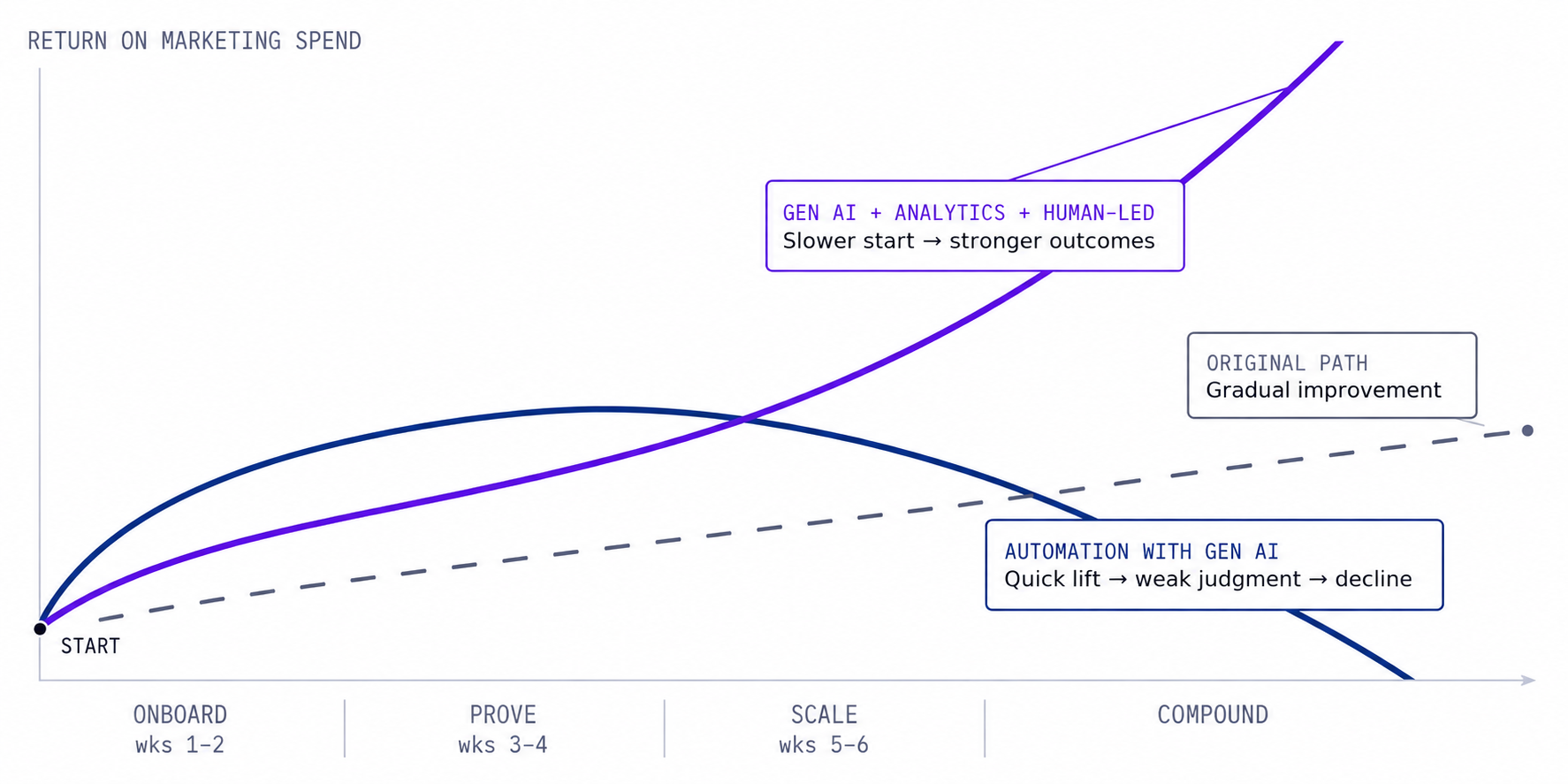
Neither automation nor a language model guarantees a better decision. Don't just automate. Optimize.
Not the last one that worked. The last one you could defend with evidence — a number, a mechanism, a reason it moved. For most teams the honest answer is that the decision got made anyway: a persona written in a workshop three years ago, a channel budget set by last-click, a quarterly explanation assembled after the fact to fit a number nobody predicted.
This is not a tooling shortage. More data. More channels. More analytics. More Gen AI. More automation. More integrations. Each one opens a real growth opportunity and adds another system somebody has to run, connect, and trust. The stack got more complicated. The decisions did not get more informed.
And it is not a shortage of intelligence. Guesswork is not a human failing that a model corrects — it is what any intelligence does when the signal is missing. Give a person no attribution and they fall back on instinct. Give a language model the same missing data and it does the same, faster and more fluently, with no reason to expect the better answer and none of the hesitation that tells you someone is unsure. What changes the decision is not who makes it. It is whether anything measured is in front of them.
In the accounts we audit, we typically find 40–80% of digital ad spend going nowhere. Less mature teams sit at the top of that range; even sophisticated organizations leak around 40%. That is not a spending problem. It is what guessing costs, compounded every quarter it goes unmeasured.
| The decision | How it's made today | In the Semantic Brain App |
|---|---|---|
| Who your customer actually is | Personas from a workshop, written once, rarely revisited | Semantic IQ — demographic, psychographic, and behavioural analysis built from your own data |
| Which channel earns the next dollar | Last-click, platform-reported numbers, or whoever presents best | Semantic IQ — an attribution baseline across GSC, GA4, Google Ads, and LinkedIn |
| Why the number moved | A plausible story assembled after the fact | Semantic IQ — diagnostic analysis with root cause and the reasoning attached |
| What to change next | The team's best instinct | Semantic IQ — prescriptive recommendations, ranked |
| Whether the underlying data is even correct | Assumed | Audit IQ — tracking, configuration, and pipeline inspected before any of the above runs |
What we kept finding inside customer accounts:
None of those teams knew. They were reporting confidently — to boards, to clients, to their own executives — on numbers that were wrong before anyone read them. Budgets moved on those numbers.
Audit until the data is real. Optimize until the decisions are defensible. Automate last.
And it compounds. Automating on top of a leak accelerates it.
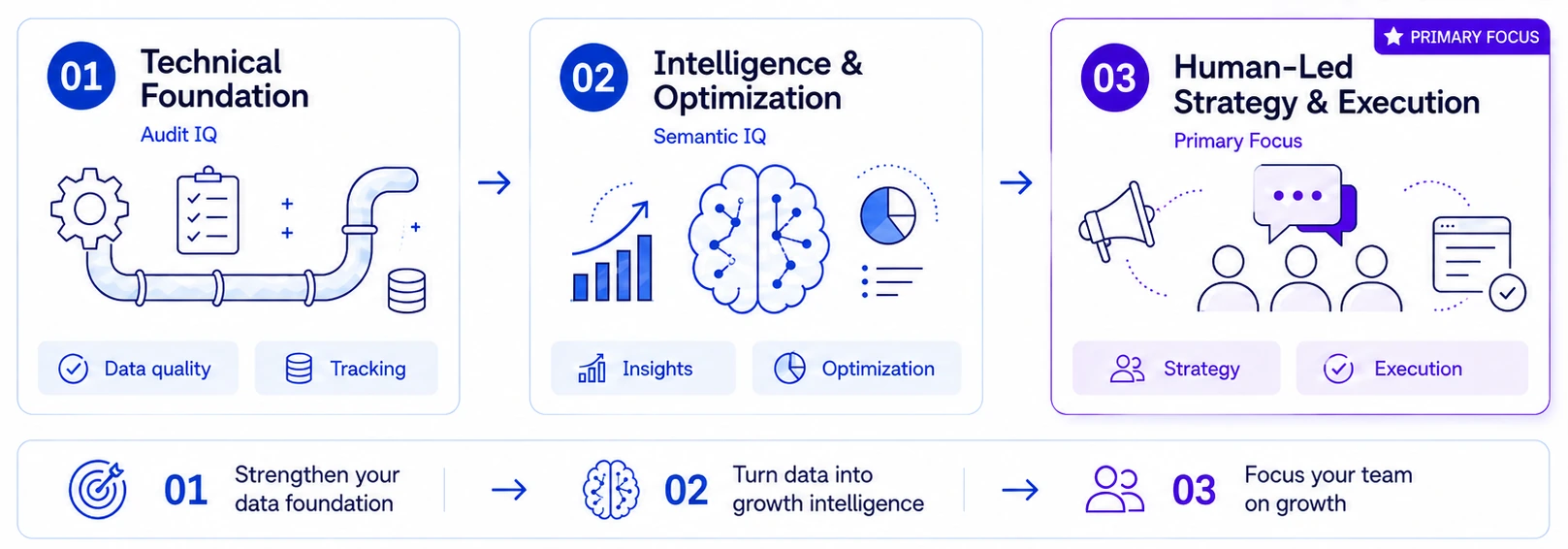
Growth runs on three layers. Semantic Brain powers the foundation and the intelligence. Your team leads strategy and execution.
Semantic IQ is the core of the Semantic Brain App and the reason the rest of it holds. It establishes attribution, finds the signal, and returns decisions rather than dashboards.
This is the layer that actually moves the business — and it stays yours. Semantic Brain assists here too, through chat, MCP, content generation, and analysis, but the highest-value work remains human-led.
Semantic Brain is a Growth Intelligence platform powered by Analytics + Gen AI. Today, we help companies apply that intelligence primarily to marketing and sales — finding opportunities to increase conversions, customers, and revenue while reducing waste.
Semantic Brain is a single application unifying three proprietary technologies. The full process can run autonomously, but sales and marketing teams can step in at any point to shape it — no data-science background required.
A business audit identifies what data you actually need. A technical audit ensures your pipeline delivers it cleanly — from GSC, GA4, Google Ads, and LinkedIn. Periodic execution enables continuous data governance.
The deliverable: deep diagnostic insights and prescriptive solutions — the optimization itself. The foundation: reliable attribution. A baseline is established at onboarding, then continuously scanned for signal across channels and campaigns. An LLM reasoning layer turns signal into diagnostics and prescriptions.
Generative AI for content creation and task execution — only now it's operating on clean data and verified attribution, not assumptions. The same Gen AI everyone else uses, applied with intelligence.
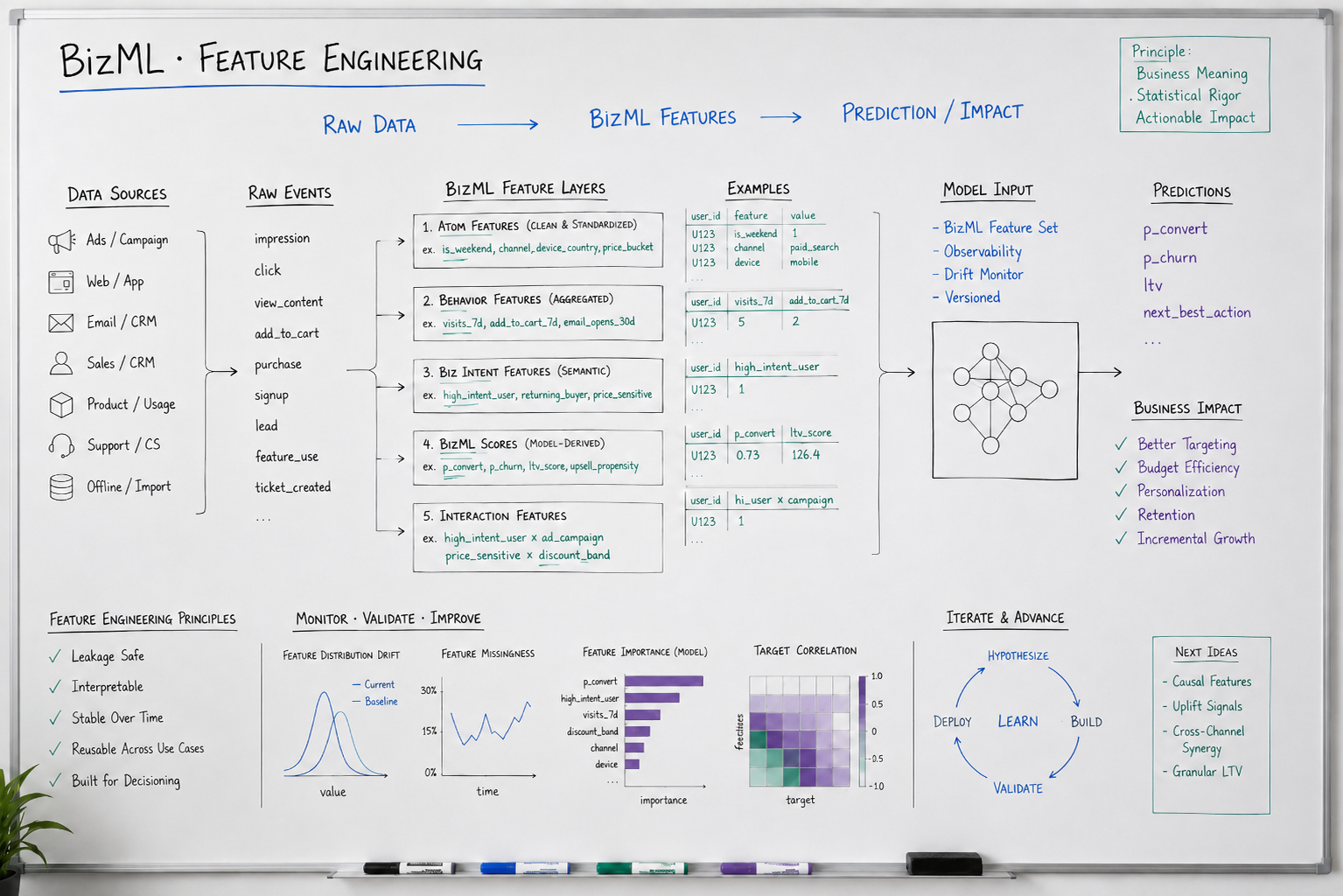
Semantic IQ is the product of the Semantic Brain App. BizML is the patent-pending core inside it — feature-engineering and selection methods that improve prediction accuracy, reduce error rates, and increase explainability for the people who have to trust and defend the output.
The technology was originally built for quantitative investing and trading: seven customers, more than fifteen production projects. We then embedded it into Semantic IQ to optimize marketing first, and sales next.
Four ordered layers: first the truth, then the artifacts, then execution, then the memory that compounds.
Demographic, psychographic, behavioural, organic search, and Google Ads analysis.
Persona + ICP, segmentation, buyer behaviour, and brand voice — current and recommended.
Ad changes, new ads, SEO + social content, sales messaging, and GTM planning.
Organized around 5Cs — Company, Customer, Content, Channel, and Competition — so every analysis and campaign sharpens the next one instead of starting from zero.
One platform, four contexts. The framework adapts to how your organization actually sells — whether you're a B2B SaaS team trying to plug a leaky funnel or an agency moving from billable hours to results-based engagements.
Gen AI has commoditized content execution. Agencies that demonstrate measurable results — with attribution — win the next contract. Audit IQ also helps identify gaps and pipeline issues before onboarding, making it easier to prioritize and sell.
Read more For B2BBusiness buyers spend only 6% of their time with any vendor, and 67% now prefer a rep-free buying experience. Analytics can pinpoint exactly where you're losing them — particularly in sales-heavy organizations that have underinvested in digital infrastructure.
Read more For B2CSemantic IQ, working from Google data, identifies who your customers actually are and how they actually buy — rather than guessing. That means better segmentation, sharper targeted messaging across SEO, social, and paid, and significantly less wasted ad spend.
Read more For SaaSSaaS companies operate as B2B, B2C, or both — but they have two unique opportunities: streamlining sales and marketing during the critical first 30 days of app usage, and enhancing the product itself with Semantic IQ-powered dashboards, reports, or embedded intelligence.
Read moreSemantic Brain is a Toronto-based analytics company. The leadership team has spent years building investing, marketing, and CRM applications. BizML — our patent-pending engine — was first deployed in the investment domain; we then applied it to marketing and sales.
We are not a creative agency. We don't ship content for the sake of it. We build the intelligence layer that makes content — and the Generative AI that produces it — actually work.
What operators ask before the first call. Short, specific, and honest about the mechanism.
Point an OpenAI or Anthropic agent at raw GA4 and Google Ads data and one of two things happens: it hallucinates, or it returns recommendations that quietly cost you money. Either way, token costs climb and the budget leaks.
Those tools execute. They do not decide what is worth executing. Semantic Brain structures the Analytics first — establishes attribution, separates signal from noise — then puts Gen AI to work on clean data instead of assumptions. The same Gen AI everyone else has, applied to better inputs.
First results land inside the three-to-four-week window. The work compounds from there.
The free Audit IQ works entirely from publicly available information and returns an assessment of your business overview and recommendations, data pipeline issues (tracking hygiene), and technical issues across performance, SEO, and accessibility.
The catch, such as it is: it touches nothing beyond what is already public, so you have nothing to lose and walk away with concrete ways to improve. It also means we have not seen your GSC, GA4, Google Ads, or LinkedIn data yet — so we cannot quantitatively optimize from a public audit alone. That is the next step.
How it starts: you provide read-only access to GSC, GA4, Google Ads, and LinkedIn. If those are already set up properly, Semantic Brain setup takes under an hour. If there are issues, Audit IQ identifies them and we advise your team on the fixes; your team handles the cleanup, then we set up Semantic Brain. We align on attribution and a baseline, then help you optimize and automate — see How fast do I see results? above for the week-by-week.
Four tiers, priced per account or business unit.
Seats are unlimited; additional cognitive credits can be purchased. Credits track token use — a reasonable proxy for the intelligence (Analytics + Gen AI) delivered.
No. Semantic IQ is your data scientist; BizML is the tool it uses, embedded inside it. You ask the questions in plain language; the system handles the Machine Learning, on a schedule or on demand.
Access is read-only and revocable — you grant it, and you can withdraw it whenever you choose. We connect to GSC, GA4, Google Ads, and LinkedIn, none of which expose personally identifiable information. We read the signals that drive attribution and optimization. We do not collect your customers' personal data.
Both. BizML came out of a hedge-fund advisory project in November 2021, then moved into advertising quickly: our first ad customer launched in April 2022, when a security SaaS company raised conversions by 700% after increasing marketing spend just 7% to fund ads.
Since then we have applied BizML across advertising, social media, influencer scoring, and churn prediction — real experience with GSC, GA4, Google Ads, and LinkedIn, not only market data. Audit IQ and Semantic IQ are recent; the engine underneath them has four years of production behind it.
Every demo includes a complimentary Audit IQ — a public business and technical audit of a target account before any access is required. If the account moves forward, connected data lets you quantify the leak, optimize spend, and prove outcomes.